
Thursday, September 30, 2021
Prageeta Sharma
Poem for Leigh Hunt
I find ways to keep a sense of peace but it is not always easy; for example, I can't keep my questions tempered. What kind of sun expounds its rays upon the hills but then mutes like an ordinary bulb, small and self-contained? Moreover, what moon filters the blistering whiteness of snow so that it can only be seen by the fiscally immune, enamored by the dully-noted? Let me amble with Keats and his wandering expression and try to figure out if the poem keeps me encased in a rapture for which my dim external life won't account.
CONCEPTUAL WRITING
Against Expression, An Anthology of Conceptual Writing
Editors Craig Dworkin and Kenneth Goldsmith have put together an expansive collection of conceptual writing—an emergent early 21st century movement practiced by poets such as Christian Bök, Caroline Bergvall, Robert Fitterman, Vanessa Place, Darren Wershler-Henry, and many more.
This compilation gathers the primary documents of the movement's key practitioners as well as obscure texts by writers such as Denis Diderot, William Burroughs, Hart Crane, W. B. Yeats, that help to inform its experimental tradition.
To practice what the book preaches, by appropriating text directly from its back cover, one might say:
Against Expression is the premier anthology of conceptual writing, charting a trajectory of the conceptual aesthetic from early precursors such as Samuel Beckett and Marcel Duchamp through major avant-garde groups of the past century, including Dada, Oulipo, Fluxus, and language poetry, to name just a few. The works of more than a hundred writers from Aasprong to Zykov demonstrate a remarkable variety of new ways of thinking about the nature of texts, information, and art, using found, appropriated, and randomly generated texts to explore the possibilites of non-expressive language.
As Goldsmith says in an interview with Poets.org:
The best thing about conceptual poetry is that it doesn't need to be read. You don't have to read it. As a matter of fact, you can write books, and you don't even have to read them. My books, for example, are unreadable. All you need to know is the concept behind them.
Though one does not have to read the whole anthology to understand it, Against Expression serves as an invaluable resource for exploring this international literary movement.
Robert Fitterman
Rob Fitterman
from "A Hemingway Reader": The Sun Also Also Rises

About his writing practice, Fitterman says, "Experimental poetry has a long shelf life. Even if the community is small, the conversation could be vital to the future of the art."
To look and to listen requires the work of attention, selection, reappropriation, a way of making one's own film, one’s own text, one's own installation out of what the artist has presented.
—Jacques Rancière
Book I
Chapter I
I am very much impressed by that. I never met any one of his class who remembered him. I mistrust all frank and simple people. I always had a suspicion. I finally had somebody verify the story. I was his tennis friend. I do not believe that. I first became aware of his lady's attitude toward him one night after the three of us had dined together. I suggested we fly to Strasbourg. I thought it was accidental. I was kicked again under the table. I was not kicked again. I said good-night and went out. I watched him walk back to the café. I rather liked him.
Chapter II
I am sure he had never been in love in his life. I did not realize the extent to which it set him off until one day he came into my office. I never wanted to go. I had a boat train to catch. I like this town. I can't stand it to think my life is going so fast and I'm not really living it. I'm not interested. I'm sick of Paris. I walked alone all one night and nothing happened. I was sorry for him but it was not a thing you could do anything about. I sorted out the carbons, stamped on a by-line, put the stuff in a couple of big manila envelopes and rang for a boy to take them to the Gare St. Lazare. I went into the other room. I wanted to lock the office and shove off. I put my hand on his shoulder. I can't do it. I didn't sleep all last night. I could picture it. I have a rotten habit of picturing the bedroom scenes of my friends.
Chapter III
I sat at a table on the terrace of the Napolitain. I watched a good-looking girl walk past the table and watched her go up the street and lost sight of her. I caught her eye. I saw why she made a point of not laughing. I paid for the saucers. I hailed a horse-cab. I put my arm around her. I put her hand away. I called to the cocher to stop. I had picked her up because of a vague sentimental idea that it would be nice to eat with some one. I had forgotten how dull it could be. I got hurt in the war. I was bored enough. I went back to the small room. I went over to the bar. I drank a beer. I could see their hands and newly washed, wavy hair in the light from the door. I was very angry. I know they are supposed to be amusing. I walked down the street and had a beer at the bar. I knew then that they would all dance with her. I sat down at a table. I asked him to have a drink. I was a little drunk. I got up and walked over to the dancing-floor. I took my coat off a hanger on the wall and out it on. I stopped at the bar and asked them for an envelope. I took a fiftyfranc note from my pocket.
Chapter IV
I saw her face in the lights from the open shops. I saw her face clearly. I kissed her. I was pretty well through with the subject. I went out onto the sidewalk. I did not see who it was. I wanted to get home. I stopped and read the inscription. I knocked on the door and she gave me my mail. I wished her good night and went upstairs. I looked at them under the gaslight. I got out my check-book. I felt sure I could remember anybody. I lit the lamp beside the bed. I sat with the windows open and undressed by the bed. I looked at myself in the mirror of the big armoire beside the bed. I put on my pajamas and got into bed. I had the two bull-fight papers, and I took their wrappers off. I read it all the way through. I blew out the lamp. I wonder what became of the others. I was all bandaged up. I never used to realize it. I lay awake thinking and my mind jumping around. I couldn't keep away from it. I started to cry. I woke up. I listened. I thought I recognized a voice. I put on a dressing-gown. I heard my name called down the stairs. I looked at the clock. I was getting brandy and soda and glasses. I went back upstairs. I took them both to the kitchen. I turned off the gas in the dining-room. I had felt like crying. I thought of her walking up the street. I felt like hell again.
Chapter V
I walked down the Boulevard. I read the papers with the coffee and then smoked a cigarette. I passed the man with the jumping frogs. I stepped aside. I read the French morning papers. I shared a taxi. I banged on the glass. I went to the office in the elevator. I was looking over my desk. I held him off. I left him to come to the office.
Chapter VI
I sat down and wrote some letters. I went down to the bar. I looked for her upstairs on my way out. I saw a string of barges being towed empty down the current. I suppose it is. I walked past the sad tables. I watched him crossing the street through the taxis. I never heard him make one remark. I do not believe he thought about his clothes much. I don't know how people could say such terrible things. I don't even feel an impulse to try to stop it. I stood against the bar looking out. I did not want anything to drink and went out through the side door. I looked back. I went down a side street. I got in and gave the driver the address to my flat.
Chapter VII
I went up to the flat. I put the mail on the table. I heard the door-bell pull. I put on a bathrobe and slippers. I filled the big earthenware jug with water. I dressed slowly. I felt tired and pretty rotten. I took up the brandy bottle. I went to the door. I found some ash-trays and spread them around. I looked at the count. I had that feeling of going through something that has already happened before. I had the feeling as in a nightmare of it all being something repeated, something I had been through and that now I must go through again. I took a note out of my pocket. I looked back and there were three girls at his table. I gave him twenty francs and he touched his cap. I went upstairs and went to bed.
Note from the author: "When I was 13, my brother gave me a copy of Hemingway's The Sun Also Rises. It was my first foray into real Literature and I hated it. Even with little or no way to enter the novel, I dutifully slugged through it (I mean, what is cog-nak anyway?) Years later, I have returned to revisit the relationship. In this version, I have erased my way through Hemingway's original text, leaving behind only the phrases that begin with the pronoun 'I'."
Copyright © 2009 by Robert Fitterman. Used with permission of the author.
Allen Ginsberg
All afternoon cutting bramble blackberries off a tottering brown
fence
under a low branch with its rotten old apricots miscellaneous under
the leaves,
fixing the drip in the intricate gut machinery of a new toilet;
found a good coffeepot in the vines by the porch, rolled a big tire out
of the scarlet bushes, hid my marijuana;
wet the flowers, playing the sunlit water each to each, returning for
godly extra drops for the stringbeans and daisies;
three times walked round the grass and sighed absently:
my reward, when the garden fed me its plums from the form of a
small tree in the corner,
an angel thoughtful of my stomach, and my dry and lovelorn tongue.
Wednesday, September 29, 2021
Jonathan Franzen
This distinction between real and ersatz virtue is the central preoccupation of “Crossroads”—so much so that Franzen, who historically wears his thematic concerns on his dust sleeve (“Freedom,” “Purity,” “The Corrections”), might have titled this new novel “Goodness,” if the word didn’t double as an awkward exclamation. It is true that “Crossroads” is also concerned, like every Franzen novel, with the makeup and the breakdown of American families. And it is concerned, too, with the issues implied by the title he gave it: those moments in the lives of individuals and in the history of a nation when stark choices with permanent consequences must be made. But, deliberately and otherwise, the book returns again and again to the same question: What does it mean—for a person and, in a different sense, for a novel—to be good?
----Kathryn Schulz
Robert Irwin
The act of art is a tool for extended consciousness.
The act of art has turned to a direct examination of our perceptual processes.
We have chosen that experience out of the realm of expereiences to be defined as "art" because having this label it is given special attention. Perhaps this is all art means.
If that state of consciousness I keep talking about became, in a sense, the consciousness of society as a whole, if we really thought in those terms, and were really that aware, . . . really that sense-sophisticated, then our art would be an integral part of our society and the artist as a separate discipline or art as a separate event would not exist.
Perhaps the furture role of the aritst will be to act directly as the arbiter of qualities in our livess. Quality not as an add-on, as it is now, but as a criteria in all matters of planning.
Any tool you use is legitimate. The key to the tool is whether it has the dimensions to deal with what have become your questions. I consider art as a thought form more than anything else.
My art ahs never been about ideas...My interest in art has never been about abstraction; it has always been about experience. . . . My pieces were never meant to be dealt with intellectually as ideas, but to be considered experientially.
From Robert Irwin. Part 1: Prologue:x18(3) Part II: Homage to the Square
www.diacenter.org/irwin/quotes.html.
Gordon Matta- Clark
Food
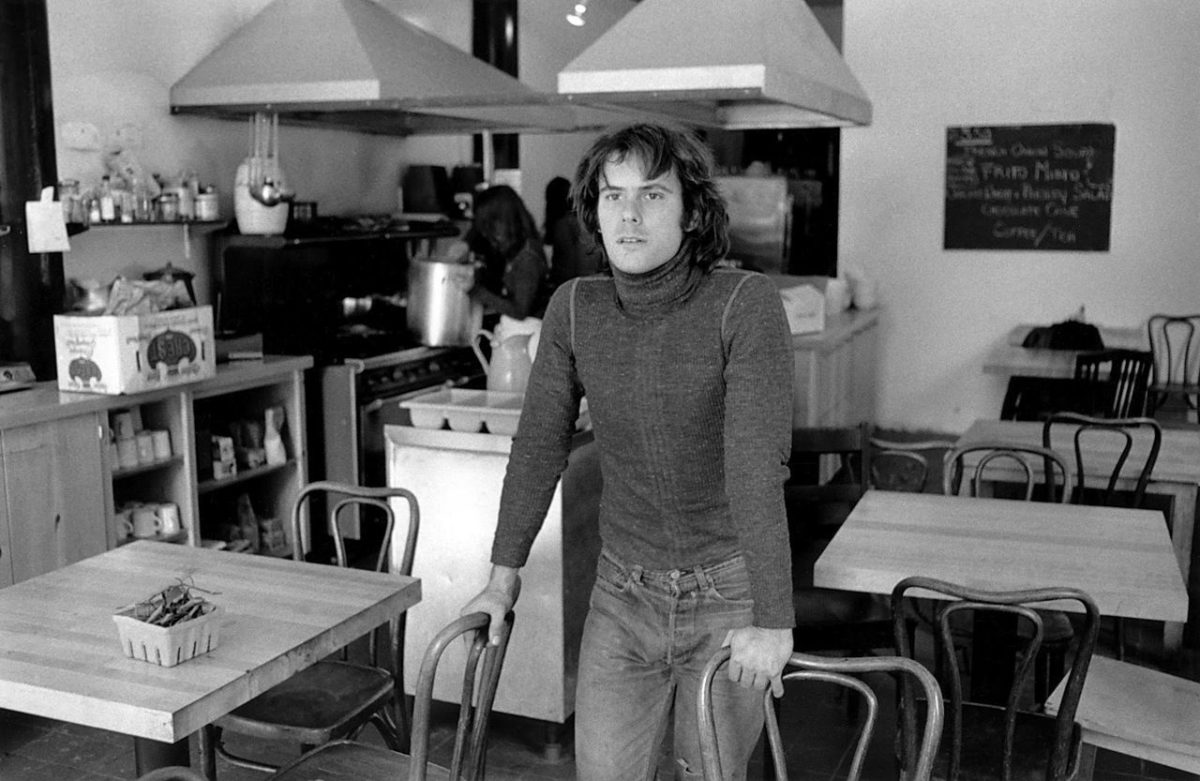
A collaborative project conceived by artists Gordon Matta-Clark, Tina Girouard and Carol Goodden in 1971, during its relatively short lifespan, FOOD established itself as a seminal moment in New York art history. The restaurant-come-relational-artwork occupied the corner of Prince and Wooster Streets, neighbouring 112 Greene Street, the longstanding and instrumental art space. It is perhaps simplest to define FOOD as a restaurant run by artists, yet that definition underestimates the project’s multifarious functions. Operating more like a community centre than a business, the establishment was decidedly sympathetic to the priorities of its employees’ lives and schedules.

Before they founded FOOD, Goodden and Matta-Clark were already cooking for artists in New York and had developed somewhat of a reputation for throwing dinner parties for friends, mainly hosted at their loft. In 1971, they roasted an entire pig under the Brooklyn Bridge; the communal roast became known as the Brooklyn Bridge Event. The event was accompanied by outdoor sculpture and celebrated the opening of the Alternative Gallery Space on Greene Street. The sculptures at the pig roast had been curated by Alanna Heiss of the Museum of Modern Art, with music by Dickie Landry and the Phillip Glass Ensemble.
Following their ventures into hosting, the pair found the idea of creating a restaurant that served fresh food in a communal setting appealed to them. At FOOD, the dishes were as much an artistic medium as a form of nutrition. Typical of FOOD’s approach was Matta-Clark’s “bone” dinner: marrow and oxtail soup, the remains cleaned at the meal’s end and strung as jewellery for the diners, which mostly comprised fellow artists, musicians, and dancers from the Downtown scene. The project lasted three years, until Goodden nearly spent her entire family inheritance investing in it.
Frances Richard on Jess

Jess, “Danger Don’t Advance,” Salvages IX (last painting), ca. 1990, oil on canvas, 44 x 18 3/4". From the series “Salvages,” ca. 1970–94.
Jess
TIBOR DE NAGY GALLERY
The painter and collagist Jess (1923–2004) had a poet in his life, of course. On New Year’s Day, 1951, he exchanged vows with Robert Duncan, sage of the San Francisco Renaissance, and they lived together for nearly four decades. But the poet that Jess’s early paintings—nineteen, made between 1950 and 1966, were exhibited here—brought to mind, for me at least, was Frank O’Hara, specifically his “Memorial Day, 1950”: “Fathers of Dada! You carried shining erector sets / in your rough bony pockets, you were generous / and they were lovely as chewing gum or flowers! / Thank you!” Jess disparaged his own graphic skill, often choosing to copy from magazines, and the jerky innocence of his hand seems limned in O’Hara’s lines, as does the eroticism, conscious of itself as overwrought yet wholly sincere, in works like Hiding Little in Big, 1959, wherein a pair of boneless swains frolic in a springtime wood composed of pigment so blobbed and gummy that it does suggest something played with by mouth and fingers. (Painted into the lower-right corner of the scene is an enigmatic artist’s or lover’s warning: HIDING LITTLE THINGS IN BIG — OK BUT THEY MAY BE LOST.) The bouquets in M is for Mud, 1961, and Petals of Paint, 1964, look literally made of stuck-on gum—and the Min the former, jigsawed from wood and marled in gray-green impasto, is stuck on too. Fans of the hallucinogenically precise collages and “paint by number”–style paintings for which Jess is best known may find these lushly awkward canvases surprising. But their relationships to the later work are piquant; the paintings, too, seem assembled from disparate parts. They are romantic as valentines, and odd as all get-out.
As a young atomic chemist, Jess Collins worked on the Manhattan Project and the Hanford Atomic Energy Project until an apocalyptic dream inspired him to quit. He studied with Clyfford Still at the California School of Fine Arts (now the San Francisco Art Institute), but it was Duncan who gave him Max Ernst’s collage-novel Une semaine de bonté, 1934. So Ernst was the “father of Dada” who inspired Jess directly, though he freely mixed the influence with traces of Pierre Bonnard’s and Édouard Vuillard’s glowing domesticity, and the moonlit eeriness of Edvard Munch or Albert Pinkham Ryder. Jess’s contemporary David Park comes to mind too. Such games of strange bedfellowship—each apt, none explanatory—are key to Jess’s charm. “What he achieved is totally his, but in every detail derivative,” as Duncan noted. The slur of lipstick on the woman in Model in Studio 15, #2, 1950–66, or the uncannily plastic anemones in Almost Daybreak, 1958, feel totally private, urgent, and bemused. Their art-historical intelligence is not thereby reduced.
The most weirdly entrancing work here was “Danger, Don’t Advance,” Salvages IX (last painting), the only late work in the show, which the artist abandoned circa 1990. For the “Salvages” series, ca. 1970–94, Jess reworked his student abstractions and, occasionally, paintings bought in thrift stores. This one presents a sinuous nude in a brushy landscape. His hand presses his temple in a gesture of poet’s despair—or shepherd’s ecstasy—or perhaps he is on the phone? His unmodeled torso is scrawled over, in what looks like pencil, with an outline of a crowd scene, obviously traced from a photograph. Men in top hats and bowlers gather for some public occasion; a sign in their midst reads DANGER, DON'T ADVANCE. Apparently, deliciously bizarrely, the source for the image was the driving of the golden spike to complete the first Transcontinental Railroad, in 1869.
Rebecca Wolff
The Ungovernable
William Blake
Blake at Felpham
William Blake, Letter to John Flaxman, September 21,1800
Aaron Shurin
Cool Dust
Plume
David Melnick
Men in Aïda, they appeal, eh? A day, O Achilles!
Allow men in, emery Achaians. All gay ethic, eh?Paul asked if teach mousse suck, as Aïda, pro, yaps in.
Here on a Tuesday. ‘Hello,’ Rhea to cake Eunice in.
‘Hojo’ noisy tap as hideous debt to lay at a bully.
Ex you, day. Tap write a ‘D,’ a stay. Tenor is Sunday.
Atriedes stain axe and Ron ideas ’ll kill y
Cedar Sigo 2

Now I'm a Woman
The poet Susan Howe, 77, at right, and her daughter, the painter R. H. Quaytman, 53, in Quaytman’s house, designed by the American sculpto...
-
California Hills in August I can imagine someone who found these fields unbearable, who climbed the hillside in the heat, cursing the dust...
-
Contemporaries and Snobs after Laura Riding Jackson There's a structure for idiocy—lamplight— all over the nation; it's an illumi...
-
Choose Life (excerpt) Choose life instead of those prisms with no depth even if their colors are purer Instead of this hour always hidden...
