ELEPHAN'TWIRL

A tale of some reading & commonplace thing? People's poems

Blog Archive

  • ►  2021 (672)
    • ►  September (156)
    • ►  October (352)
    • ►  November (163)
    • ►  December (1)
  • ▼  2022 (2)
    • ▼  January (2)
      •  Stories of New NarrativeSeptember 16, 2017   •   ...
      •  The poet Susan Howe, 77, at right, and her daught...

Friday, October 1, 2021

Elaine Equi


I Don’t Wish to Be a Vampire

With centuries of memory
stored in a youthful body.

It is – or could be – such a pleasure
if we didn’t fear it so much,

to get old and indulge in
subversive acts of dawdling,

withering, forgetting with impunity,
letting go of ambition served too long,

its bitter sweet ligatures finally breaking
down and dissolving.

While others feverishly train
body and brain in gyms,

let me cultivate the corpse flower,
listen to it like a radio in a small room

quietly playing its hypnotic
melodic overture of decomposition.


By Rodney Phillips at October 01, 2021 No comments:
Email ThisBlogThis!Share to XShare to FacebookShare to Pinterest

Robert Bly


Robert Bly

Robert Bly read and talked at Tempe's Changing Hands Bookstore
last Thursday evening. He was really charming, and his reading style
was very attractive. Easy going, familiar (I would imagine Mark Twain
was a little like this). Reading short poems twice really helps you to
hear what you are hearing.His interjections in the form of exhortations or
explanations also helped one listen. The poems he read from his new book 
were really nice (funny, smart ghazal like poems, two of which are 
in the current Poetry magazine). He also read a number of translations
which were particularly affecting. Bly handed out free copies of his
anti Iraq book, which pleased a number of the crowd immensely. 
Hmmmm. The crowd was mostly older, with no more than a half
dozen under 40. But about seventy five people in all were in the 
audience crowded into the reading area of the bookstore. People
loved his jokes.
By Rodney Phillips at October 01, 2021 No comments:
Email ThisBlogThis!Share to XShare to FacebookShare to Pinterest

James Schuyler


Schuyler's poems can sometimes stop readers in their tracks - not because of any infelicitous choice of word, or the dull drop of a participle, but from sheer and joyful surprise (“I keep my Diamond necklace in a pond of sparkling water for invisibility”). A master of the sudden and unusual intrusion (of another state of consciousness, a flamboyant character, or an elegant twist of fate), Schuyler was a postmodern nature poet, who wrote convincingly of the weather, of garden f
lowers, and of “malevolent argeratums,” carefully noting “a too pungent salad” and “the smoke blazing over Jersey.” Everything and everyone in his sometimes skinny poems is clearly, tenderly observed: “All things are real/no one a symbol.” Schuyler was also a careful observer in a meditative way of living life in the city: 

The Morning

breaks in splendor on 
the window glass of
the French doors to
the shallow balcony
of my room with a 
cast iron balustrade
in a design of flowers,
mechanical and coarse
and painted black:
sunburst of a coolish
morning in July. I
almost accept the fact
that I am not in
the country,, where I
long to be, but in
this place of glass
and stone-and metal,
let's not forget
metal-where traffic sounds and the day
is well begun. So 
be it, morning.

As an observer, Schuyler partakes of a postmodern type of buddhist, or quietest christian calmness
and hope in the face of no hope: 

Things should get better as you
grow older, but that
is not the way. The way is inscrutable and hard to handle.
-----from "A Few Days
By Rodney Phillips at October 01, 2021 No comments:
Email ThisBlogThis!Share to XShare to FacebookShare to Pinterest

Ron Silliman


Silliman and Wordsworth


This from poet Tom Thompson (Wordsworth and Common Speech) on the Academy of American Poets website: 

"When Charles Bernstein praises Ron Silliman’s poems, he positions the work precisely against the type of poem championed by Wordsworth’s Preface: Silliman’s poems "may discomfort those who want a poetry primarily of personal communication, flowing freely from the inside with the words of a natural rhythm of life, lived daily" (Content’s Dream). Admiring how Silliman’s poems work against "official verse culture," Bernstein makes it official: The Preface, written to support a poetic "experiment" in 1800 is now the rule. Wordsworth, of course, wrote against his own "official verse culture," and did so precisely by writing "from the inside with the words of a natural rhythm of life, lived daily." 

One of the things I like about Ron Silliman's poetry is that it does reflect a life lived daily. Of all the Language poets he is the most down to earth, the most non theoretical, the most "daily." Not the most inside, but the most outside. So, I am a little startled by Bernstein's comment. Silliman's poems work against official verse culture by the way they present daily life and thought, directly and without any terribly formal structure (except some Jackson MacLow/John Cage chance operational structures here and there). They are not romantic, nor lyrical in the way of much "official verse culture." But, reflecting "a natural rhythm of live, lived daily." that they do. Better than anyone now writing. And in interesting language. But, maybe I am reading a different Ron Silliman than some other people. You know, like the New York Times you read in your head, that was never really published ("Oh, I'm sure I saw that in the Times." )
By Rodney Phillips at October 01, 2021 No comments:
Email ThisBlogThis!Share to XShare to FacebookShare to Pinterest
Labels: Language Wrting

Lyn Hejinian


 from My Life: A name trimmed with colored ribbons

A name trimmed            They    are   seated   in    the   shadows
with colored                     husking   corn, shelling   peas. Houses
ribbons                              of wood set in the   ground.   I try to
                                            find the spot at which the pattern on               
                                            the   floor   repeats.   Pink,   and rosy,
                                            quartz. They   wade   in brackish water.
                                            The    leaves    outside    the window   
tricked the eye, demanding that one see them, focus on them,   
making it impossible to   look   past   them, and though holes   
were opened through the foliage, they were as useless as port-  
holes underwater looking into a dark sea, which only reflects   
the room one seeks to look out from. Sometimes into   
benevolent and other times into ghastly shapes. It speaks of a   
few of the rather terrible blind. I grew stubborn until blue as   
the eyes overlooking the bay from the bridge scattered over   
its bowls through a fading light and backed by the protest of   
the bright breathless West. Each bit of jello had been molded   
in tiny doll dishes, each trembling orange bit a different   
shape, but all otherwise the same. I am urged out rummaging   
into the sunshine, and the depths increase of blue above. A   
paper hat afloat on a cone of water. The orange and gray   
bugs were linked from their mating but faced in opposite   
directions, and their scrambling amounted to nothing. This   
simply means that the imagination is more restless than the   
body. But, already, words. Can there be laughter without   
comparisons. The tongue lisps in its hilarious panic. If, for ex-   
ample, you say, “I always prefer being by myself,”   and, then,   
one afternoon, you want to telephone a friend, maybe you   
feel you have betrayed your ideals. We have poured into the   
sink the stale water in which the iris died. Life is hopelessly   
frayed, all loose ends. A pansy suddenly, a web, a trail   
remarkably’s a snail’s. It was an enormous egg, sitting in the   
vineyard—an enormous rock-shaped egg. On that still day   
my grandmother raked up the leaves beside a particular   
pelargonium. With a name like that there is a lot you can do.   
Children are not always inclined to choose such paths. You   
can tell by the eucalyptus tree, its shaggy branches scatter   
buttons. In the afternoons, when the shades were pulled for   
my nap, the light coming through was of a dark yellow, near-   
ly orange, melancholy, as heavy as honey, and it made me   
thirsty. That doesn’t say it all, nor even a greater part. Yet it   
seems even more incomplete when we were there in person.   
Half the day in half the room. The wool makes one itch and   
the scratching makes one warm. But herself that she obeyed   
she dressed. It talks. The baby is scrubbed everywhere, he is   
an apple. They are true kitchen stalwarts. The smell of   
breathing fish and breathing shells seems sad, a mystery, rap-   
turous, then dead. A self-centered being, in this different   
world. A urinating doll, half-buried in sand. She is lying on   
her stomach with one eye closed, driving a toy truck along   
the road she has cleared with her fingers. I mean untroubled   
by the distortions. That was the fashion when she was a   
young woman and famed for her beauty, surrounded by   
beaux. Once it was circular and that shape can still be seen   
from the air. Protected by the dog. Protected by foghorns,   
frog honks, cricket circles on the brown hills. It was a   
message of happiness by which we were called into the room,   
as if to receive a birthday present given early, because it was   
too large to hide, or alive, a pony perhaps, his mane trimmed   
with colored ribbons.

By Rodney Phillips at October 01, 2021 No comments:
Email ThisBlogThis!Share to XShare to FacebookShare to Pinterest
Labels: Language Wrting

Susan Howe

 from My Emily Dickinson

     When I love a thing I want it and I try to get it. Abstraction of the particular from
the universal is the entrance into evil. Love, a binding force, is both envy and
emulation. HE (the Puritan God) is a realm of mystery and will always remain
unknowable, authoritarian, unpredictable. Between revealed will and secret will
Love has been torn in two.

     DUALISM: Pythagoras said that all things were divisible into two genera,
     good and evil; in the genus of good things he classified all perfect things
     such as light, males, repose, and so forth, whereas in the genus of evil
     he classified darkness, females, and so forth.
                              (Thomas Aquinas, “On the Power of God,” p. 84)

     Promethean aspiration: To be a woman and a Pythagorean. What is the communal
vision of poetry if you are curved, odd, indefinite, irregular, feminine. I go in
disguise. Soul under stress, thread of connection broken, fusion of love and
knowledge broken, visionary energy lost, Dickinson means this to be an ugly verse.
First I find myself a Slave, next I understand my slavery, finally I re-discover
myself at liberty inside the confines of known necessity. Gun goes on thinking of
the violence done to meaning. Gun watches herself watching.


By Rodney Phillips at October 01, 2021 No comments:
Email ThisBlogThis!Share to XShare to FacebookShare to Pinterest
Labels: Language Wrting

Mark Strand

 Eating Poetry 

Ink runs from the corners of my mouth.
There is no happiness like mine.
I have been eating poetry.

The librarian does not believe what she sees.
Her eyes are sad
and she walks with her hands in her dress.

The poems are gone.
The light is dim.
The dogs are on the basement stairs and coming up.

Their eyeballs roll,
their blond legs burn like brush.
The poor librarian begins to stamp her feet and weep.

She does not understand.
When I get on my knees and lick her hand,
she screams.

I am a new man.
I snarl at her and bark.
I romp with joy in the bookish dark.


By Rodney Phillips at October 01, 2021 No comments:
Email ThisBlogThis!Share to XShare to FacebookShare to Pinterest

Thursday, September 30, 2021

John Ashbery


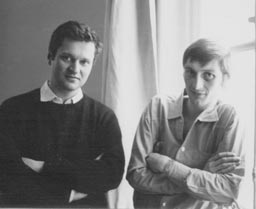
John Ashbery, Lee Harwood, 1965. Photo by Pierre Martory, courtesy of the estate of Lee Harwood.

Ashbery Talking

John Ashbery in Conversation with Mark Ford, published in London by BTL (Between the Lines, 2003) is one of the best interviews I have ever read. Ashbery is open, willing to talk and seems not only really smart but sweet. Perhaps the fact that the two are friends or at least friendly acquaintances accounts for this, but Mr. Ford's smart questions also show a deep familiarity with Ashbery's work. It does seem like a conversation. The 80-page bibliography, which makes up the last part of the book, looks exhaustive and the selections from reviews are cleverly chosen. In fact, a quote from the somewhat notorious first review of Some Trees by Wm. Arrowsmith in the Hudson Review which is intended as negative, seems eerily the reverse: 
“What does come through is an impression of an impossibly fractured brittle world, depersonalized and discontinuous, whose characteristic emotional gesture is an effete and cerebral whimsy.” 

I particularly like this bit by Ashbery where he talks about the way he writes: 

“ How dos a poem begin, and end, for me these days? Well, very much as it always has. A few words will filter in over the transom, as they say in publishing, and Ill grab them and start trying to put them together. This causes something to happen to some other words that I hadn't been thinking of which may well take over the poem to the pint of excluding the original ones. What prompts me to start is a vague feeling that I ought to write a poem, and what 'urges' (rather too strong a word) me to stop is a sudden feeling that it would be pointless to continue.” 


By Rodney Phillips at September 30, 2021 No comments:
Email ThisBlogThis!Share to XShare to FacebookShare to Pinterest
Labels: NY School, Queer

Dashiell Hammett


"Scorched Face"

“I climbed Telegraph Hill to give the house the up-and-down. It was 
a large house---a big frame house painted egg-yellow. It hung dizzily on 
a shoulder of the hill, a shoulder that was sharp where rock had been 
quarried away. The house seemed about to go skiing down on the roofs 
far below. 
It had no immediate neighbors. The approach was screened by 
bushes and trees.” 

*** 

“A room with three girls and a man crouching in a corner, fear in their 
faces. Neither of them was Myra Banbrock, or Raymond Elwood, or any- 
one we knew. 
Our glances went away from them after the first quick look. 
The open door across the room grabbed our attention. 
The door gave to a small room. 
The room was chaos. 
A Small Room packed and tangled with bodies. Live bodies, seething, 
writhing. The rooms was a funnel into which men and women had been 
poured. They boiled noisily toward the one small window that was the 
funnel's outlet. Men and women, youths and girls, screaming, struggling, 
squirming, fighting. Some had no clothes.” 

---Dashiell Hammett, “Scorched Face,” originally published in 
Black Mask, May, 1925 and reprinted in Nightmare Town (1948) 
and The Big Knockover (1966). 

This is both tautly and elegantly written and clumsy at the same time. 
The Continental Op, who is called "Fat Shorty" by an adversary, is good 
hearted and relentless at the same time. He destroys all sorts of evidence 
to protect his client and other young girls who have been drugged, orgied 
and blackmailed. The second paragraph is terse and quick and good. 
The scene is San Francisco, but except for that and Telegraph Hill and 
the names of the characters athere are no proper names used anywhere 
in the story. The twist is in the very last sentence. 

posted by RodneyPhillips @ 1:48   0 commen

By Rodney Phillips at September 30, 2021 No comments:
Email ThisBlogThis!Share to XShare to FacebookShare to Pinterest
Labels: Novels

Gerty Gerty Stein

 Author and poet, Gertrude Stein dressed in dark clothes, sitting on a sofa with a side table to the right of the picture

Stein on Writing Revised

Gertrude Stein on Writing: a list [in process] 

1926Compositon as Explanation/Descriptions of Literature1927An Elucidation1929An Acquaintance with Description1931Saving the Sentence/Sentences and Paragraphs/Arthur, a Grammar/A Grammarian/Sentences/Regular regularly, in narrative/Finally George, a vocabulary of Thinking/Forensics1935What is English Literature/Pictures/Plays/The Gradual Making of Making of Americans/Portraits and Repetitions/Poetry & Grammar/Narration, Lectures 1-4/How Writing is Written1937Why I Like Detective Stories1940What are Masterpieces1946A transatlantic Interview1895/1949Radcliffe Themes 

1 
“Composition as Explanation (1926) 6pp. 
[Written and delivered as a lecture at Oxford, 1926. Published 
in the Dial (October 1926) and in Composition as Explanation 
(Hogarth Press, 1926). Text also included in What are Masterpieces (1940), Selected Writings (1946), Writings and Lectures, 1911-1946 (1967) and in the Library of America Gertrude Stein: Writings 1903-1932 (1999). 

2 
“Descriptions of Literature” (1926) 8pp. 
[Published as Stable Pamphlet no. 2 by George Platt Lynes and Adlai Harbeck, Englewood New Jersey, also published in transition (Summer 1928) and in Reflections on the Atom Bomb in 1973] 

3 
“An Elucidation” (1927) 16pp. 
[Originally published in transition no. 1 (April 1927) and published in a corrected version as a pamphlet the same year, also included in A Primer for the Gradual Understanding (1971) 

4 
"An Acquaintance with Description" (1929) 
Published and hand set by Robert Graves and Laura Riding (Mallorca, Seizin Press, 1929, and included in Library of America Gertrude Stein: Writings 1903-1932 (1999). 

5 
How to Write (1931) 
"A difference between a noun and a verb is not seen in wishes and wishes" 
[This collection originally published in Paris by her own Plain Edition Press, and later (1973) reprinted by the Something Else Press and again in 1975 by Dover.] It includes, all first published here: 
“Saving the Sentence” 
“Sentences and Paragraphs” 
“Arthur, a Grammar” 
“A grammarian” 
“Sentences” 
“Regular regularly, in Narrative” 
“Finally, George, a vocabulary of Thinking” 
“Forensics” 

6 
Lectures in America (1935) 
"Gerty Gerty Stein is Back Home Home Back" (newspaper headline). 
[These lectures were written for Stein's American lecture tour of 1934-35. She and Toklas arrived in New York City on October 24, 1934 and in the course of six months Stein delivered over 40 lectures. Stein and Toklas left for Europe on May 4, 1935]. 
Included in this volume and first published here, are: 
“What is English Literature” 
“Pictures” 
“Plays” 
“The Gradual Making of Making of Americans” 
“Portraits and Repetitions” 
“Poetry & Grammar” 
[All but “Plays” are included in Writings and Lectures, 1911-1946, no. 10 below] 

7 
Narration (1935) 
[This collection of four lectures written while on her lecture tour in 1934-35 was first published by the University of Chicago Press in 1935. The Lectures are numbered 1 through 4] 
Lecture 1 “The contrast between the English daily life and the American lack of a daily life” 
Lecture 2 'Narrative in prose and narrative in poetry” 
Lecture 3 “History and the newspaper as narrative” 
Lecture 4 “The Audience and the Novel and the Mystery Story as narrative” 

8 
What are Masterpieces (1940) 
[First published in Los Angeles by Conference Press in 1940, this includes addresses delivered before the Cambridge and Oxford Literary Societies] 
Includes: 
“Composition as Explanation” [originally published in 1926, see above] 
“What are Masterpieces and why are there so few of them” [first published here] 

9 
Selected Writings of Gertrude Stein (1946) 
[Edited by Carl Van Vechten and first published by Random House in 1946 in 10,000 copies and in 1962 as Modern Library Book ML322 in 7,500 copies] 
Includes: 
“The Gradual Making of the Making of Americans” [originally published in Lectures in America (1935), 
see above] 
“Composition as Explanation” [originally published in 1926, see above] 

10 
Writings and Lectures, 1911-1945 (1967) 
[Edited by Patricia Meyrowitz published in Londoon by Peter Owen in 1967 and reprinted by Penguin in 1971 as Look at Me Now and Here I Am] 
Includes: 
“Composition as Explanation”[originally published in 1926, see above] 
“What is English Literature” 
“The Gradual Making of the Making of Americans” 
“Portraits and Repetitions” 
“Poetry and Grammar” 
“What are Masterpieces and why are there so few of them” [originally published in 1940, see above] 
“Henry James” [originally published in Four in America (1947)] 
[All but “Composition as Explanation,” “What are Masterpieces” and “Henry James” published in 
Lectures in America (1935), see above] 

10 
A Primer for the Gradual Understanding of Gertrude Stein (1971) 
[Edited by Robert Bartlett Hass and published in Los Angeles by Black Sparrow Press in 1971] 
Includes: 
“A Transatlantic Interview” [interview done in 1946] 
"Radcliffe Themes 91895)" [originally published in Gertrude Stein: Form and Intelligibility, by Rosalind S. 
Miller. Exposition Press, 1949] 
“An Elucidation” [originally published in transition, April 1927 with garbled text and reissued correctly as 
a pamphlet in April 1927] 

11 
How Writing is Written (1974) 
[Edited by Robert Bartlett Hass and published by Black Sparrow Press in 1974] 
Includes; 
“Why I like Detective Stories” [originally published in Harper's Bazaar,November 1937] 
“How Writing is Written” [originally delivered as a lecture on January 12, 1935 at Choate School and 
published in Choate Literary Magazine, February 1935] 

posted by RodneyPhillips @ 7:02 PM  0 comments 


By Rodney Phillips at September 30, 2021 No comments:
Email ThisBlogThis!Share to XShare to FacebookShare to Pinterest
Labels: Avant-garde, Queer

Iris Murdoch


The nice are not always the good

Iris Murdoch's eleventh novel, The Nice and the Good was published in England by Chatto and Windus in 1968 and Nominated for the Booker Prize in 1969, along with The Public Image by Muriel Spark, but P. H. Newby's Something to Answer for one the prize, this the first time it was given. 

What some reviews said about Iris: 

Bernard Bergonzi in TNYRB, April 11, 1968 says: 

“Iris Murdoch's annual novel now seems to have become an established British institution: in private it may be derided or dismissed, but in public it gets the respect customarily given to venerable traditions” 

“This richly peopled novel revolves around a happily married couple, Kate and Octavian, and deals with love in its many aspects. The resonant sub-plot involves murder and black magic as the novel leads us through stress and terror to a joyous conclusion.” 

Elizabeth Janeway in the NYTimes, January 14,1968 

One expects complications, revelations, tricks and red herrings, invitations to guess at what is coming, echoes, jokes and clues. One gets them aplenty. And because they are so solidly introduced by the thriller opening -- that shot, that necessary investigation -- the premise of the book justifies and sustains them. this is a mystery story, says Miss Murdoch. I am simply using its conventions. But the mystery she is exploring is the universal ambiguity of living creatures in relation to each other, of good behavior and bad, of pleasure and pain, of responsibility, obligation, influence, meddling and neglect; or, if you like, of the Nice and the Good. 

John Ducane, the hero, the “detective” descends to the underground, a dazzling structure of a book, including a variety of involvements, to advance the plot. But the ideas are not new…the nice are not the good…. 

[There are a variety of twos in this novel: two Children, Henrietta and Edward, two pets, a dog Mingo and a cat,, Two teenagers, two older men (maybe gay?), two formerly marrieds.] 

“tanglings and untanglings' as John Russell says in the New York Times Feb. 22, 1990 

“The pre Raphaelite painter Arthur Hughes, her equivalent in paint, “ 
says Anatole Broyard in the New York Times, October 5, 1986 

More Broyard:  

Her characters: 
They have some of the grandiosity and high purpose, the heroic sense of themselves, that characters in Victorian novels had. Their lives are crammed with moral furniture and philosophical gingerbread. 

Mr. Conradi, God bless him, tells us that these same people also ''toy with the sublime.'' Here are men and women I've been longing to meet. I've always wanted to know someone who toyed with the sublime. Has anyone in American fiction toyed with the sublime since Thomas Wolfe let Eugene Gant do it in ''Of Time and the River''? Some wonderful teacher - Meyer Schapiro, perhaps - ought to give a course in the subject. In the 1980's, it's hardly worthwhile being human unless you toy occasionally with the sublime. 

In spite of her intelligence, she believes in happiness, which she defines as ''that deep, confiding slow relationship to time.'' 

and Joyce Carol Oates in The New Republic, November 18, 1998, later revised for The Boston University Journal, 1999. 

There is something noble about a philosopher's quixotic assumption that he or she is the person to protect others from despair; or, indeed, that others require protection from despair. But Murdoch's sense of her mission is noble, and in an era when some of our most articulate spokesmen routinely denigrate their own efforts it is good to be told, I think plausibly, that literature provides a very real education in how to picture and comprehend the human situation, and that for both the collective and individual salvation of the race, art is more important than anything else, and literature most important of all. (See The Sovereignty of Good.) 

One is left with silly inconsequential but deeply absorbing plots. Emotions that feel "genuine" and "existential" enough but are, of course, illusions, sheer phantasmagoria. One is left with other people who are, whether they acknowledge it or not, involved in the same fruitless, albeit highly engrossing, quest. 
By Rodney Phillips at September 30, 2021 No comments:
Email ThisBlogThis!Share to XShare to FacebookShare to Pinterest
Labels: Novels

Motherwell


Robert Motherwell


Robert Motherwell

Notes on: Robert Motherwell, with selections from the artist's writings, by Frank O'Hara. New York, Museum of Modern Art, 1965. 

Frank O'Hara's monograph on Robert Motherwell portrays a man of immense personal charm, if a somewhat reticent charm compared to Jackson Pollock say. In the selections from his writings (chosen by Bill Berkson), there is talk about stubbornness, objectivity, openness, human contact and other values not that often in the forefront of artistic credos. Motherwell evidences what might be a deep knowledge of poetry and literature, philosophy and psychology. “I love Hopkins' insistence on particularization,” he says in one of his statements. It isn't the perception that Hopkins was a detailing poet of specific and material beauty, but that he is insistent about it that is the fine touch. Motherwell's work is political and big, only one of which is unusual afor an abstract expressionist. 

O'Hara's writing seems a little clumsy from time to time: “With the advent of war, a heterogeneous number of American artists whose only common passion was the necessity of contemporary art's being Modern began to emerge as a movement. . .” or “Motherwell's special contribution to the American struggle for modernity was a strong aversion to provincialism. . . . “ Not very interesting and certainly beside the point? However, he does warm up as he keeps going, and has several perceptive points to make: 
“Certain of the abstract expressionists seem to have burst into paint with an already emergent personal force from the very first works we know---one things particularly of Motherwell and Barnett Newman. The variety from period to period in each of these artists encompasses a broadening of technical resources. . . and moves in a steadily rising power of emotional conviction. They have had a conviction if not a style, from the beginning, more ethical than visual, which has left them free to include anything useful and has fuided them away from the peripheral.” This is a very smart point, especially in regard to Motherwell, who appears to have (or have destroyed them if he did) no early clumsy, unknowledgeable works. “The Little Spanish Prison,” (1941-44) and “Pancho Villa, Dead and Alive” (1943) are both the stunning looking and assured works of a mature painter. “The Homely Protestant” (1948) looks bold and big though it is only 4feet by 8feet big. O'Hara, with a good head for a story, tells us that the title came from Motherwell's blindly pointing to a phrase in Finnegan's Wake. The chronology by Kynaston MacShine is fun to read for a list, but there is no mention of what happened to Mrs. Motherwell number one, only a short note for 1950 : “Marries Betty Little of Washington, D. C.” The next thing you know two daughers are born and in 1957 the note “Meets Helen Frankenthaler” and in 1958 Marries Helen Frankenthaler in the Spring. There are pictures of Frankenthaler with the Motherwell daughters in 1961-62 and “Motherwell with Helen Frankenthaler in front of their house in Provincetown. . . summer, 1962.” No note tells us about the fate of Betty Little, dead or divorced, Heathcliff. The black and white illustrations don't work all that well for the paintings, but there are some great pieces of ephemera (for instance, a poster for an exhibition at Sidney Janis Gallery, 1959 with MOTH/ERW/ELL on three lines like a poem). There is an amazing one page “Catalogue for 1948-49” for The Subje t of the Artists: a new art School,” with faculty noted: William Baziotes, David Hare, Robert Motherwell, Mark Rothko. Barnett Newman was to join later. Can you imagine this school? Amazing. One evening a week for a term is $45. Photographs are also of some note: “Artists' session at Studio 35, an informal panel discussion on modern art recorded stenographically and printed in part in Modern Artists in America.” The photograph shows a long table split in two, one half upside down, mirror like, with everyone who was anyone sitting around the table, nearly thirty artists, including Louise Bourgeois, Max Ernst, Richard Pousette-Dart, Barnett Newman, Ad Rheinhardt Bradley Tomlin, etc. Come to think of it, it is probably two different photographs as Pousette-Dart appears in both halves. The Selective bibliography compiled by Bernie Karpel of the Museum Library is thorough and fascinating in itself (for instance, listed are a complete listing of the “Documents of Modern Art” series that Motherwell edited for Wittenborn and a Portable Gallery Robert Motherwell! This is 42 color slides and an addition of 30 slides. What a resource, what a kick. Also listed as in the MOMA Library Collection are 50 negative stirps of Photographs of Motherwell in 1957-58 given to the Library by the photographer Hans Namuth (more famous for his Life Magazine pictures of Jackson Pollack). 


By Rodney Phillips at September 30, 2021 No comments:
Email ThisBlogThis!Share to XShare to FacebookShare to Pinterest
Labels: Art

Rodney Phillips


Pins

“India contributes the ooze of her rivers and the blood of dragons and elephants.” 
Pliny 

Elliott Hundley 
Provincetown, Fine Arts Work Center, 
Exhibition: February 13 - February 19, 2002 

Five pieces: wall sculptures, mosaics, mobiles, pin cushions 

If Jim Hodges married Sara Sze. 

materials: little plastics, figures, straws, what nots 
pins, bright pins everywhere, carpets of pins on the walls, shiny 
color form story picture, hidden things, the heart for instance 

Cave: 
Pictures of jewels under the overlip of plastic…there are Tanqueray plastic leafs in the upper right…spyglasses in the upper left, among tropical plastic ”straws” 

Bonfire: 
has a donkey in it…a rocket at the top with more little rockets, a big old mess, but a geometrical mess, a nest of brown dissolution, where on the right are pieces of chests, men's chests, torsos as it were, Saint Sebastian…A big eel is on the very left lower middle… 
and somewhere else up to the left are cocktail napkins in the cocktail colors of pink, orange and purple, if you even want to call them that. 

The Wreck: 
a brown placemat is falling apart, like a shipwreck indeed…. crooked… 
plastic bag pieces and silver pins, glimmering, transcending wreck. 
A little silver heart, white heart, pearl heart hidden or half hidden underneath the major body of the wreck, with a tiny bit of robin's egg blue paper…triangular….the rope is untied and curled on the left… 

Cage: 
has a paper pic of a cage almost in the middle…to the left and down, dangling…things dangle a lot in Elliott's paintings….There are shells, pictures of shells rather a the top and plastic leafs, flower petals taken apart everywhere…the overall color of this piece is white, but there are rolled up pieces of colored paper around, mainly on the bottom left… 
This is the prettiest? The lightest 

Night Garden: 
critical mass of materials: black at the top and red below, red rockets 
on the left lifting into the black, where there are many pieces of black paper with sparkles or white dots, the universe.. 
fragmented, the thing here are the green plastic pieces like little shelves in the middle, above the middle across, there are little Chinese war lord figures here and there… a wheel of fortune broken apart….. 

************ 

All in all these works are little scenarios, windows into? scenic wonders: roads not taken, roads taken and abandoned. Hearts lost, like Hearst, only. In which all is not well, no. Deliquescence, 

Delicate, delicacies derived from the dump 
a sense of opera, of heartbreak, love and intrigue, triumph 
but also duels, or fights, cul de sacs, ends of things….. 
what about the snakes and the eels, pretty as they are? 
and the body parts, now what to do with the fact you don't care they are body parts? 
vortex, whirlpool of little things…the universe of little things… 

By Rodney Phillips at September 30, 2021 No comments:
Email ThisBlogThis!Share to XShare to FacebookShare to Pinterest

W. H. AUDEN


W. H. Auden

O Where Are You Going?

    "O where are you going?" said reader to rider,
    "That valley is fatal where furnaces burn,
    Yonder's the midden whose odours will madden,
    That gap is the grave where the tall return."

    "O do you imagine," said fearer to farer,
    "That dusk will delay on your path to the pass,
    Your diligent looking discover the lacking,
    Your footsteps feel from granite to grass?"

    "O what was that bird," said horror to hearer,
    "Did you see that shape in the twisted trees?
    Behind you swiftly the figure comes softly,
    The spot on your skin is a shocking disease."

    "Out of this house"---said rider to reader,
    "Yours never will"---said farer to fearer
    "They're looking for you"---said hearer to horror,
    As he left them there, as he left them there.

If I Could Tell You

Time will say nothing but I told you so,
Time only knows the price we have to pay;
If I could tell you I would let you know.

If we should weep when clowns put on their show,
If we should stumble when musicians play,
Time will say nothing but I told you so.

There are no fortunes to be told, although,
Because I love you more than I can say,
If I could tell you I would let you know.

The winds must come from somewhere when they blow,
There must be reasons why the leaves decay;
Time will say nothing but I told you so.

Perhaps the roses really want to grow,
The vision seriously intends to stay;
If I could tell you I would let you know.

Suppose all the lions get up and go,
And all the brooks and soldiers run away;
Will Time say nothing but I told you so?
If I could tell you I would let you know.


By Rodney Phillips at September 30, 2021 No comments:
Email ThisBlogThis!Share to XShare to FacebookShare to Pinterest
Labels: british, Queer

Max Jacob

 Poem in a Mode that Isn't Mine 


to you, Rimbaud

My horse tripped over the semiquavers! The notes splatter up to the green sky of my soul: the eighth sky!

Apollo was a doctor and me I’m a pianist of the heart, if not in fact. It would be necessary, with the flats and all the bars, to unload the scribbled steamers, to collect the tiny battle flags to compose some canticles.

The minuscule, it’s huge! Whoever conceived Napoleon as an insect between two branches of a tree, who painted him a nose too large in watercolor, who rendered his court with shades too tender, wasn’t he greater than Napoleon himself, o Ataman Prajapati!

The minuscule, it’s the note!

Man bears upon himself photographs of his ancestors like Napoleon bore God, o Spinoza! Me, my ancestors, these are the notes of harps. God had conceived St. Helena and the sea between two branches of a tree. My black horse has a good eye, though albino, but he tripped on the harp notes.

By Rodney Phillips at September 30, 2021 No comments:
Email ThisBlogThis!Share to XShare to FacebookShare to Pinterest
Labels: Surreallist
Newer Posts Older Posts Home
Subscribe to: Posts (Atom)

  The poet Susan Howe, 77, at right, and her daughter, the painter R. H. Quaytman, 53, in Quaytman’s house, designed by the American sculpto...

  • Dana Gioa
      California Hills in August I can imagine someone who found these fields unbearable, who climbed the hillside in the heat, cursing the dust...
  • Prageeta Sharma
      Contemporaries and Snobs  after Laura Riding Jackson There's a structure for idiocy—lamplight— all over the nation; it's an illumi...
  • Andre Breton
      Choose Life (excerpt) Choose life instead of those prisms with no depth even if their colors are purer Instead of this hour always hidden...

Search This Blog

  • Home

About Me

Rodney Phillips
Hi. Former knowledge worker Poet Curator New York City. Person, Provincetown person
View my complete profile

Report Abuse

Labels

  • 19th century
  • 2000&after
  • 30s
  • 50's
  • 60's
  • 70's and after
  • 70's and before
  • Arab american
  • Arab-Americans
  • Art
  • ASIAN-AMERICAN
  • Avant-garde
  • beats
  • Black Folk
  • black mountain
  • british
  • classic
  • confessional
  • contemp
  • CONTEMPORARY
  • dada
  • Deep image
  • French
  • Greek
  • indigenous
  • intermedia
  • irish
  • italian
  • Language Wrting
  • Latinx
  • mid-century
  • Modernist
  • nba
  • New Narrative
  • nobel prize
  • Novels
  • NY School
  • NYS 2nd Generation
  • NYS 2ndGeneration
  • objectivist
  • POC
  • portugese
  • prose poems
  • pulitzer
  • Queer
  • russian
  • s
  • SF Renaissence
  • SF Renaissence queer
  • sonnet
  • spanish
  • surrealist
  • Surreallist
  • White men
  • Women

Blog Archive

  • January 2022 (2)
  • December 2021 (1)
  • November 2021 (163)
  • October 2021 (352)
  • September 2021 (156)
Simple theme. Powered by Blogger.